What is Ada?
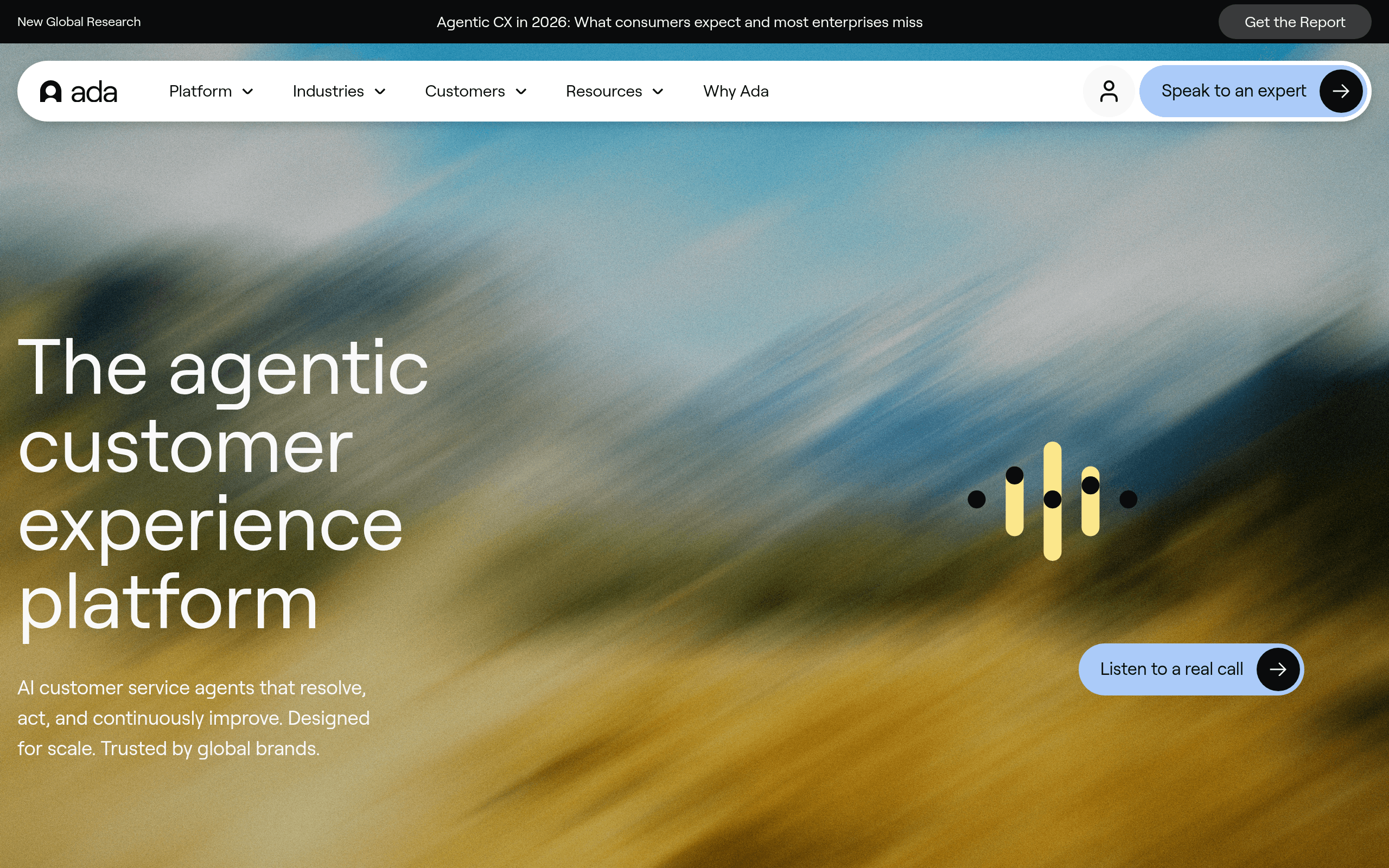
Ada is enterprise-grade AI customer support automation. The platform builds and manages an AI agent that handles support across chat, email, voice, and messaging, drawing from your knowledge base, ticketing history, and product data to give grounded answers.
What Ada sells is automated resolution rate, not just deflection. Its reasoning engine tries to actually solve customer problems, refunding an order, changing a shipping address, resetting a password, rather than pointing at an article. The AI uses tools, meaning your APIs, to take real actions inside the conversation.
Most "AI chatbots" return article links. Ada returns resolved tickets. When your top issues require doing something on the customer's behalf, that action-taking layer is the difference between deflecting 20 percent of volume and resolving 50 percent.
The platform spans multiple channels from one agent:
- Live chat on web and mobile
- Email reply automation
- Voice for phone-based support
- Messaging across WhatsApp, SMS, Facebook Messenger, and others
- Internal employee support (HR, IT, ops)
Common workflows by role:
- Support leads configure the AI agent against the existing knowledge base
- Operations teams wire up API integrations so the AI can take real actions
- Customer success monitors resolution patterns and content gaps
- Engineering builds custom tool integrations for in-product actions
- Support leadership tracks deflection and CSAT alongside human teams
The analytics layer surfaces what the AI couldn't handle, why, and how to fix it. Coverage gaps become measurable instead of vibes-based. A question that fails 100 times this week turns into a clear backlog item: write the help doc, train the agent on it, retest.
A few specifics worth knowing:
- The reasoning engine grounds answers in your knowledge sources rather than hallucinating
- Tool use (your APIs) lets the AI take real actions in customer accounts
- Multichannel coverage means one agent across chat, email, voice, and messaging
- Coverage analytics turn unresolved cases into measurable improvement work
Where Ada fits best:
- Mid-market and enterprise support teams with high ticket volume
- Operations with a mature knowledge base for grounding
- Products where many support questions involve taking actions (not just answering FAQs)
- Customer experience teams measuring resolution rate as a business metric
The integration story spans:
- CRM and helpdesk platforms (Zendesk, Salesforce, Intercom, others)
- E-commerce platforms for order and account actions
- Knowledge base sources (Notion, Confluence, Salesforce, custom)
- Identity and authentication for personalized customer actions
Ada is built for serious operations where AI-driven resolution rate is a measurable business outcome. Early-stage SaaS with light support volume, or any team that just needs simple FAQ deflection, will get the same job done with a lighter chatbot tool and none of the enterprise overhead.
Enterprise pricing on custom annual contracts, scaling by monthly automated conversations, channel coverage breadth, and integration depth.
Best for mid-market and enterprise support teams with high ticket volume and a mature knowledge base for grounding. Not ideal for early-stage SaaS with light support volume, where simpler chatbot tools cover the use case at lower cost.