What is Triple Whale?
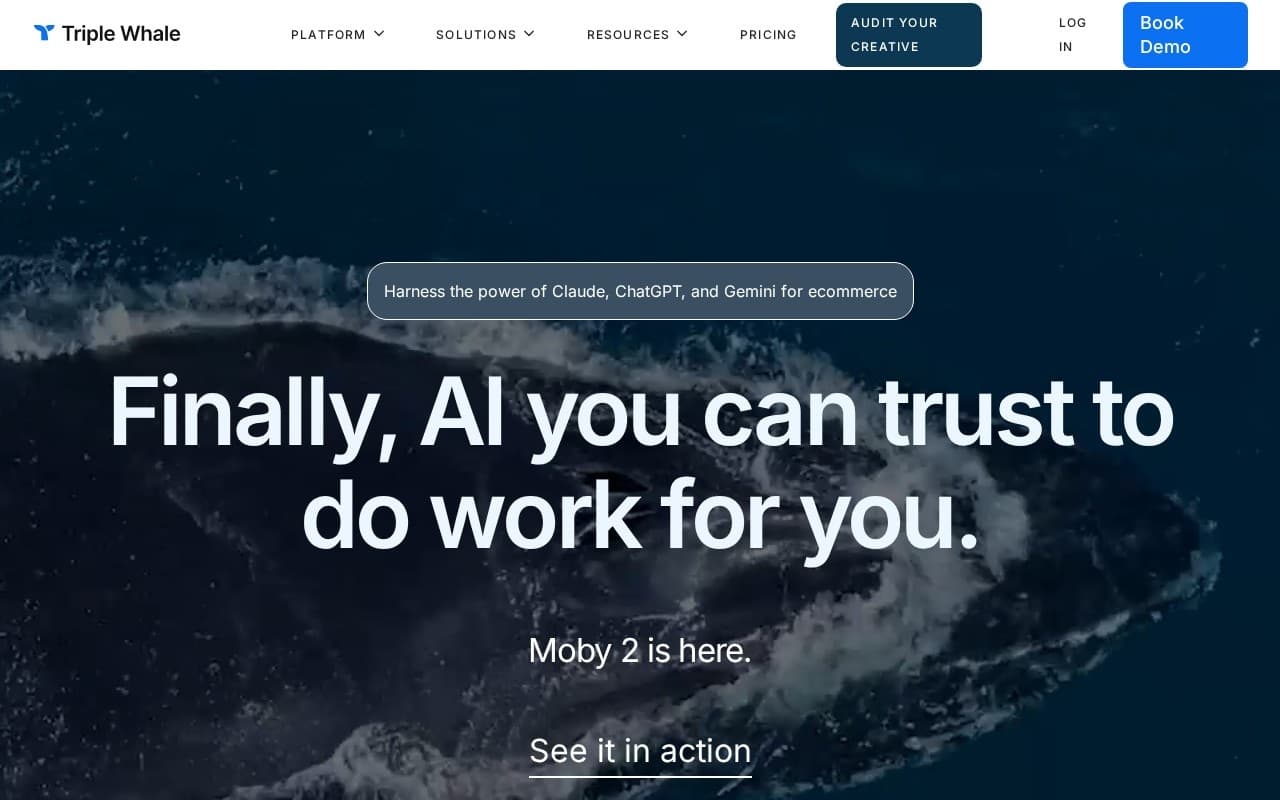
Triple Whale is an attribution and analytics platform built for DTC ecommerce brands, with an AI assistant called Moby that explains what your ad data is actually telling you. Instead of staring at a dashboard of Meta, Google, and TikTok spend wondering why CAC spiked, you ask Moby and get the answer in conversational form.
It lives in the gap between having ad data and knowing what to do next. Most ecommerce marketing teams have all the dashboards already. What they don't have is time to slice the data the right way to find why a particular cohort underperformed or which creative variant carried the week. Moby does that slicing for you.
The core platform handles the foundational stuff first:
- Multi-touch attribution across Meta, Google, TikTok, Snap, Pinterest, Klaviyo, and post-purchase surveys
- First-party pixel for tracking that survives iOS 17 and cookie deprecation
- Cohort analysis by acquisition source, campaign, creative, and first product purchased
- LTV modeling so you can compare paid channels on long-term value, not just first-purchase ROAS
- Creative-level reporting that ties Meta and TikTok ad performance back to actual revenue
Moby AI sits on top of that. Ask it questions in plain English:
- "Why did our blended ROAS drop yesterday?"
- "Which creative variant drove the most new customers last week?"
- "Compare the LTV of customers acquired via Meta vs TikTok for our hero SKU"
It pulls from the same data your team is already using and writes back conclusions with the supporting numbers attached. Less opening a CSV to pivot, more reading the answer and shipping the next test.
Common workflows by role:
- Performance marketers use Moby for daily standup-style insights without opening five tabs
- Heads of growth use cohort and LTV views to set channel mix and budget across quarters
- Creative strategists tie ad performance back to specific creative variants
- Founders skim Moby's daily summary instead of waiting for a Monday report
The dashboard tooling also supports the bits attribution platforms usually punt on: Slack alerts for spend or ROAS anomalies, scheduled exports to the C-suite deck, and integrations with Klaviyo for audience syncing back into email flows.
A few specifics worth knowing:
- Pixel install is required for the attribution model to work end-to-end
- Native integrations cover the major DTC ad and email platforms (Meta, Google, TikTok, Klaviyo, Shopify, Postscript, Recharge)
- Pricing scales by ad spend tracked, integrations connected, and Moby AI usage
- Strong fit for Shopify-native brands; less native to BigCommerce or custom stacks
For B2B SaaS, lead-gen heavy marketing, or non-ecommerce businesses, the model doesn't translate. Triple Whale assumes every revenue event happens on your storefront and gets attributed back to ad spend. Without a clear conversion event tied to a transaction, the math gets fuzzy.
Paid subscription with tiers scaling by ad spend tracked, integrations connected, and Moby AI usage.
Best for DTC ecommerce brands spending six figures a month or more on paid ads who want attribution and AI insights in one place. Not ideal for B2B, lead-gen, or non-ecommerce businesses where conversion isn't a transaction tied to ad spend.